How to Advertise on YouTube: A Step-by-Step Guide
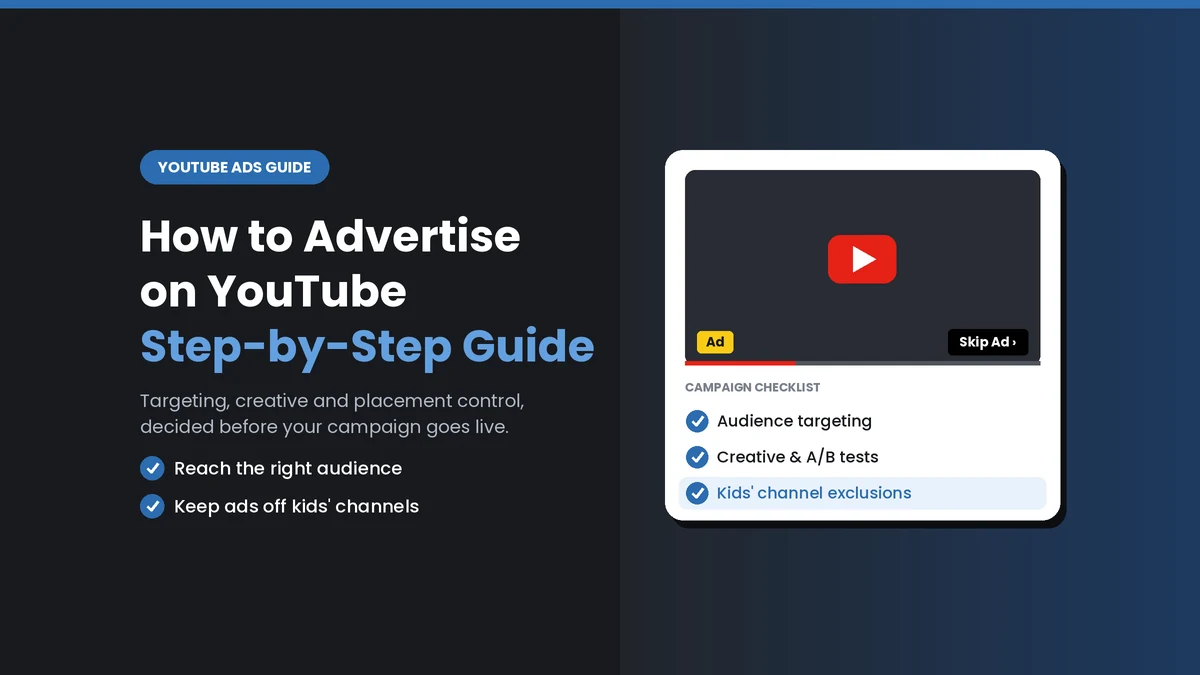
We spend a lot of time keeping ads off content they don’t belong near at Exclude Kid Channels. That work gives us an unusually close look at how YouTube advertising actually plays out – where campaigns do well, where budget quietly disappears, and where a brand ends up in a spot nobody planned for.
This guide is built around what we’ve picked up along the way, from audience targeting to the mistakes we see on a fairly regular basis. If you’re trying to figure out how to advertise on YouTube without burning through your budget in the first week, most of it comes down to decisions made before anything goes live.
Targeting Your Ideal Audience
Targeting is where a campaign gets decided before the first ad ever runs. YouTube’s tools are genuinely capable, but they won’t do the thinking for you.
Why demographic targeting still matters
Demographic targeting covers the fundamentals – age, gender, parental status, household income. We usually suggest starting a bit broader than feels right within your core demographic, then pulling back based on what the data actually shows. It’s easy to cut out viewers who would have converted because they don’t match your assumed customer profile.
How interest and affinity targeting reach engaged viewers
Interest and affinity audiences are built around online behavior, not just who someone is on paper. Affinity audiences tend to perform well for awareness goals. Custom intent audiences – the ones shaped around specific interests – usually get better results when the product serves a narrower need. Knowing how to run a YouTube ad that actually connects with the right people starts here, before you’ve written a single line of copy.
Using keyword targeting to align with viewer intent
Keyword targeting places your ads next to videos and search results tied to specific terms. Build your lists around the language your customers actually use. Internal product names and marketing language rarely line up with how people search.
Remarketing strategies to re-engage past visitors
Remarketing lets you go back to people who’ve already visited your site, watched your videos, or spent time with your channel. Those audiences convert at higher rates than cold ones – pretty consistently. It’s one of the more reliable advantages the platform offers.
Creating High-Converting YouTube Ad Campaigns
Good targeting puts you in the right room. What happens next is on the creative.
Writing compelling headlines and descriptions
Lead with a benefit, not a tagline. Viewers decide quickly, so the most important thing needs to come first. The description is where you fill in the rest.
Producing effective video ad creative and thumbnails
The first five seconds carry more weight than anything else in the video. Skippable formats like TrueView let viewers leave immediately – and plenty of them will, if nothing lands fast. We build creative to surface the value proposition early rather than work up to it. Thumbnails deserve real attention too, especially for discovery ads. Clear and relevant beats stylized almost every time. When you advertise on YouTube, the thumbnail is often what gets someone to click before they’ve seen a second of footage.
A/B testing strategies to optimize performance
You should test hooks, calls-to-action, lengths – usually against each other- then push budget toward what’s working. Worth doing even when the changes seem small. Minor creative tweaks can shift click-through and conversion numbers more than you’d expect.
Setting realistic conversion goals and KPIs
The right KPIs depend on where the campaign sits in the funnel. Awareness campaigns belong on view rate and watch time. Conversion campaigns need a cost-per-acquisition target. Without that separation, you’ll end up judging campaigns against the wrong benchmark entirely. Getting your YouTube ad campaign structured around the right objectives from the start is what keeps the numbers from being misleading later.
Common Mistakes to Avoid
Budget gets wasted in a handful of predictable ways. Most are preventable.
Targeting too broadly or too narrowly
Both ends of the range cause problems. Too broad and your budget reaches people with no interest at all. Too narrow and there’s almost no one left. We suggest testing audience size incrementally rather than locking into a range based on a guess.
Neglecting mobile optimization
Most YouTube viewing happens on phones. Not a new fact – but we still see ads that were clearly built for a desktop. Text that’s hard to read, calls-to-action that are awkward to tap. It’s worth checking how your ad actually looks on a small screen before it goes live.
Ignoring negative keywords and placements
This is where we do most of our work. Without exclusion lists, ads end up in strange places – irrelevant content at best, reputation problems at worst. You need to keep exclusions running for children’s content, and similar placements where a brand appearing would just be a problem – this is where we thrive at Exclude Kid Channels. Understanding how to run YouTube ads responsibly means managing where they don’t show up just as much as where they do.
Setting unrealistic expectations for ROI
Awareness campaigns don’t generate immediate returns. Their value shows up later, in recall and consideration. Expecting conversions from an awareness campaign is a reliable way to call a successful campaign a failure.
FAQs
How much does it cost to advertise on YouTube?
Depends on your bidding strategy and how competitive the space is, but most campaigns run on a cost-per-view or cost-per-thousand-impressions model, with control over both daily and total spend.
What ad format should I use for my first campaign?
Skippable in-stream ads are usually the right place to start. They’re flexible and carry less risk than non-skippable formats while you’re still learning what works.
How do I make sure my ads avoid inappropriate content?
Use our exclusion lists – channels, content categories, children’s content in particular. It’s not something you do once; we update these lists as the platform changes.
Getting Started with Confidence
YouTube advertising can work really well. It can also burn through budget fast when the targeting is off, or the creative isn’t doing its job. And even when both of those are in decent shape, where your ads actually show up is a problem that doesn’t fix itself. That’s the part we built our business around – keeping advertisers out of placements that would embarrass them while still reaching the audiences that matter.
If you’re getting ready to launch and want to get the exclusion strategy right before anything goes live, we can help with that!